Festival Solitaire: For Xmas
- 4.8
- Rating
- 100.00K
- Installs
- Free
- Price

 Analysis by App-foxy
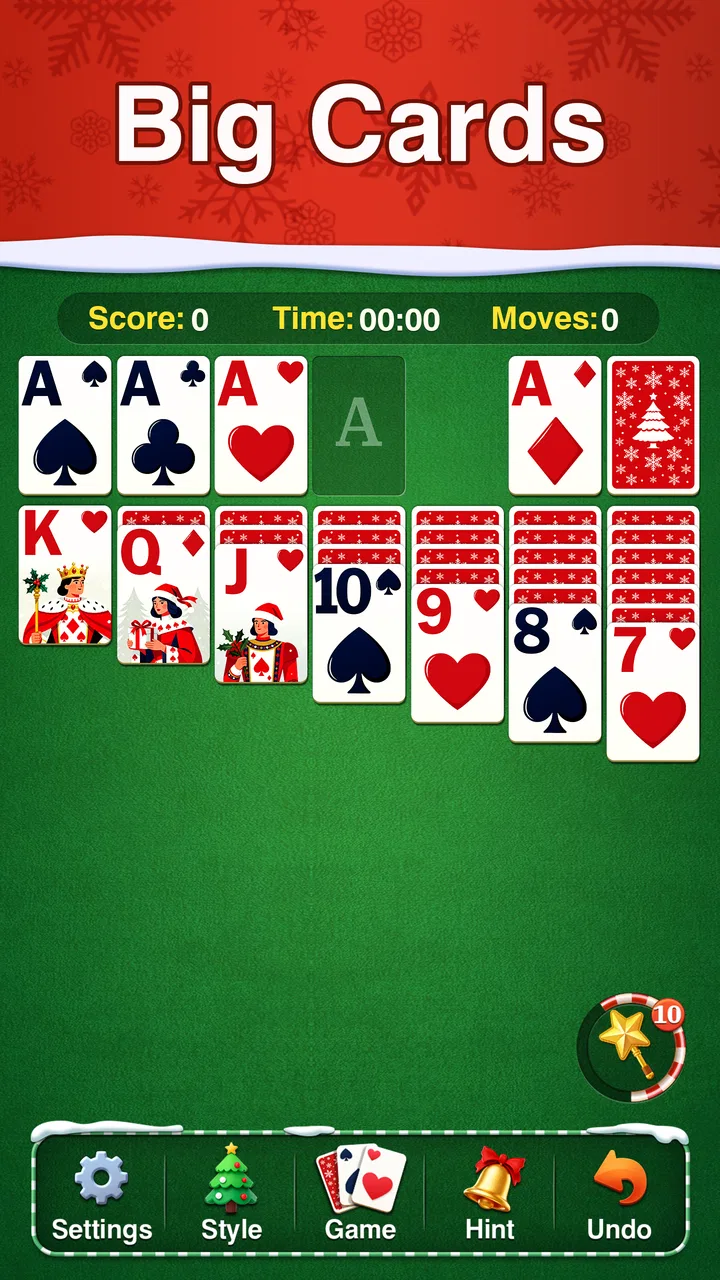
I approached Festival Solitaire: For Xmas as the kind of card game I could open for a few quiet minutes rather than a title demanding a long session. It is a festive take on Klondike solitaire from Mia Game, and the basic appeal is immediately familiar: arrange cards, uncover hidden piles, and build each suit in order. What makes this edition worth a closer look is not a radical reinvention of solitaire, but the way its seasonal presentation changes the mood of a very traditional format.
After spending time with it, I see the game as a good fit for players who enjoy a calm, repeatable card puzzle and want something more seasonal than a plain solitaire utility. It is free to download, rated for Everyone, and has reached over one hundred thousand installs. Its average rating is 4.9 from around four thousand ratings, which suggests that the straightforward concept is connecting with a large number of players. That does not make it perfect, though. The same simplicity that makes it approachable can also feel limiting if you want deep strategy, competitive play, or a large collection of modes.
How the everyday Klondike routine feels
The best way to understand this game is to ignore the Christmas wrapping for a moment and look at the daily workflow. I start a round, scan the visible tableau, and decide whether the first useful move is on the board or in the stock. From there, the familiar rhythm takes over: alternating colors in descending order, moving sequences when they open space, exposing face-down cards, and sending aces and low cards toward the foundations when doing so will not block a better move.
You May Also Like

 Blood Strike: 2.5 Anniversary
Blood Strike’s Loadouts Turn Every Drop Into a Tactical Gamble
A close look at Blood Strike’s custom loadouts: how fast access to signature weapons reshapes its battle royale rhythm, rewards preparation, and narrows the gap between fights.

 Pandora - Music & Podcasts
Pandora’s Music Is Easy to Start, but Harder to Recover
Pandora’s strength is its low-effort path from a seed to a station. Its weak spot is how much confidence it asks you to place in connection, setup, and quiet recovery.

 8 Ball Pool
 Is Built on Rivalries, Rematches, and Routine
A close look at the rivalries, rematches, shared routines, and unanswered safety questions that turn a quick pool match into a persistent mobile community.

 Samsung Music
’s Quiet Strength Is Playing What You Already Own
Its reach comes less from spectacle than from dependable access to a personal library. That simplicity is both the app’s strongest retention engine and its ceiling.

 AccuWeather: Weather Radar
AccuWeather Review: A Quick, Clear Forecast for Everyday Decisions
For everyday plans, the best forecast is the one you can understand quickly. AccuWeather makes rain timing, radar, and local conditions easy to act on, with a few trade-offs.

 Hill Climb Racing
Why Hill Climb Racing Still Turns Crashes Into One More Run
A tiny car, a bumpy hill and one more upgrade: Hill Climb Racing keeps resurfacing because its simple chaos makes every near-miss feel personal.
More From Our News Desk
View All News


That order matters more than it may seem. New players often move every available card as soon as possible, but I found that a little restraint produces better rounds. A visible low card can be more valuable in the tableau than in the foundation if it helps uncover a hidden card or frees a column. I also try to inspect the full set of legal moves before touching the stock. That small pause reduces the chance of burying a useful card behind an impulsive draw.
The festive identity works best during short breaks. I can imagine opening it while waiting for an appointment, winding down after dinner, or taking a screen break that still needs a little mental activity. It does not require the emotional investment of a role-playing game or the concentration of a competitive multiplayer title. A single round can feel like a contained task, which is exactly what I want from a casual solitaire session.
One practical habit is to treat empty columns as a resource rather than simply as empty space. In Klondike, an open column is useful because it can receive a king-led sequence, but creating one too early may leave the board awkwardly arranged. I therefore look for moves that expose a hidden card and preserve the possibility of opening a column later. This is one of the first places where the game rewards experience without needing complicated rules.
The interface and theme also affect how comfortable the routine feels. Seasonal artwork can make the game more inviting, but decorative elements should never distract from card recognition. In a solitaire game, clear suits and ranks matter more than elaborate presentation. My advice is to play a few rounds slowly at first, especially if the festive styling makes the cards feel visually busier than the plain deck you may be used to.
What I would check before settling into long sessions
Whenever I install a solitaire game, I check the available settings before playing seriously. I want to know how comfortable the cards are to read, whether the controls suit one-handed use, and whether the game gives me enough control over the pace of a round. With this title, the useful approach is not to assume that the default arrangement will suit every phone. I would spend a minute testing taps, drags, and the way cards respond when a sequence is moved.
That small setup check is especially helpful on compact screens. A solitaire board contains several columns, a stock, a waste pile, and foundation spaces, so accidental taps can become irritating if the touch targets feel close together. I prefer to use deliberate taps for single-card moves and reserve dragging for longer sequences when the destination is obvious. If your phone has a narrow display, rotating your usual grip or playing with both hands may reduce mistakes more than any strategic adjustment.
I also recommend checking whether the game’s presentation can be made comfortable for your eyes. A bright seasonal design may be pleasant during the day but less relaxing at night. If the game exposes visual or sound controls, I would adjust them before judging the experience. Solitaire is repetitive by nature, so small annoyances become noticeable over time. A readable layout and restrained audio matter more here than flashy decoration.
The game is currently version 1.0.3 and supports devices running Android 7.0 or later. That gives it a reasonably broad reach for Android users, including people who keep an older phone as a spare device. Still, compatibility is not the same as identical comfort across every screen. I would make sure the cards remain easy to distinguish on your particular handset before committing to extended play.
Because the game is free, it is easy to try without making an immediate purchase. There are in-app purchases ranging from $0.99 to $10.99 per item, so I would pay attention to any purchase prompts and decide in advance whether you want to spend anything. For me, the sensible approach is to play the free experience first and only consider an optional purchase if it solves a real annoyance or adds something I will actually use repeatedly.
The Everyone content rating also makes the game suitable for a broad household audience. That does not mean every family member will enjoy it equally. Children who want quick action may find the pace too quiet, while older players or anyone learning basic card logic may appreciate the simple structure. The rating describes accessibility of content, not the depth or excitement of the game.
Small habits that make rounds faster and cleaner
Once I become familiar with the board, I stop playing every move in isolation. I look for chains of consequences. Moving a black six onto a red seven may seem ordinary, but the real value could be the face-down card revealed underneath, the empty space created later, or the chance to relocate a longer sequence. Thinking one move beyond the obvious legal action is the difference between merely moving cards and actually improving the position.
My first repeatable pattern is to prioritize hidden-card exposure, but not blindly. If two moves are available, I usually favor the one that reveals a face-down card, provided it does not consume a useful low card or block a foundation route. Hidden cards are the main source of progress in a Klondike board, so leaving them untouched while shuffling visible cards around is often wasted time.
The second pattern is to delay foundation moves when the card is still useful in the tableau. This is a subtle trade-off. Sending an ace upward is almost always attractive, but a two or three may be needed to build a sequence that exposes another card. I ask myself whether the move improves access or merely makes the foundation look tidier. That question prevents the common mistake of advancing cards because the move is available rather than because it helps the board.
The third habit concerns kings. When a column becomes empty, I do not automatically place the first available king there. I prefer a king that carries a useful sequence or allows a face-down card to be uncovered elsewhere. An empty column can become a powerful staging area, but it can also become dead space if filled with a king that does not improve the rest of the tableau.
Stock management is another area where experienced play feels different. I try to remember which useful cards appeared in the waste pile and avoid cycling through it without a plan. If the game’s draw behavior allows you to revisit cards, the order of your choices matters even more. I make a mental note of cards that could connect with tableau columns, then choose moves that preserve access to them instead of treating every stock turn as a fresh gamble.
For a quick everyday session, I use a simple three-stage routine. First, scan the tableau without moving anything. Second, make only the moves that expose hidden cards or create a clear sequence. Third, use the stock after the board has been simplified. This is faster than tapping randomly, and it makes losses easier to understand because I can identify whether the problem was an early commitment, a blocked column, or an unfortunate stock order.
These habits are useful even if you do not care about winning every round. They make the game feel less passive. The seasonal theme provides the atmosphere, but the satisfaction comes from recognizing a better order of operations and watching the board open because of it.
Where the simple design reaches its limits
Festival Solitaire: For Xmas is not the right choice for everyone. If you want multiple solitaire variants, tournaments, elaborate progression, or a strong competitive layer, a broader card-game collection may serve you better. This title’s appeal rests on a focused Klondike experience, so players looking for constant novelty may find the loop repetitive after the seasonal charm wears off.
There is also a difference between a relaxing puzzle and a fully controllable solitaire tool. Serious players may care about detailed statistics, undo depth, deal selection, hints, or fine control over rules. I would not choose this game solely because it looks festive if your main goal is analysis or long-term performance tracking. A more feature-heavy solitaire app may be the better option for studying play patterns or comparing results over time.
The free-to-play structure deserves a realistic look as well. A free download lowers the barrier to trying the game, but optional purchases can change how comfortable the experience feels depending on their placement and purpose. I prefer not to buy anything until I understand what the free version offers in normal use. If you dislike any form of purchase prompt, even a well-made casual game can become frustrating when the commercial layer interrupts the quiet rhythm you wanted.
Another limitation is inherent to the format: Klondike can produce rounds that feel decided by the deal rather than by perfect play. Good decisions improve your chances, but they cannot turn every layout into a guaranteed win. That is not a defect unique to this game, yet it affects expectations. I enjoy it more when I treat each round as a compact logic exercise rather than demanding a flawless result every time.
The release date is October 30, 2025, so the title feels aimed at a relatively current seasonal moment rather than at players seeking a long-established solitaire platform. That can be appealing if you want a fresh Christmas-themed option. It also means I would judge it primarily as a focused casual game, not as a replacement for a mature card suite with years of accumulated features and refinements.
Who should install it, and who should pass
I would recommend it to someone who already likes classic solitaire and wants a more cheerful seasonal wrapper without learning a new ruleset. It is also a sensible pick for occasional players who need a low-pressure game for commuting, waiting rooms, or a quiet evening. The free entry point makes trying it straightforward, and the Everyone rating broadens its usefulness for shared household devices.
I would be more cautious about recommending it to a player who needs deep customization, measurable progression, or a large menu of card variants. If your ideal session involves competing against other people, chasing leaderboards, or mastering unusual solitaire rules, this focused Klondike format may feel too narrow. Likewise, if you dislike seasonal artwork once the holidays are over, the theme may have a shorter useful life for you than a neutral solitaire deck.
For a realistic routine, imagine having ten minutes before leaving for work. I would open a round, make the obvious tableau moves, and use the stock only after checking whether a hidden card can be exposed. If the board becomes awkward, I would stop rather than spend the whole break forcing a bad position. Later, during a longer evening session, I might replay the same careful habits and focus on improving decision quality instead of simply tapping faster.
That distinction is important: the game is most enjoyable when you bring a little intention to it. It does not need to become a serious hobby, but it rewards players who notice card order, preserve flexibility, and avoid rushing foundation moves. Those lessons transfer well to other Klondike games, although a different app may offer more tools for players who want to examine every decision.
My verdict after learning its rhythm
My overall impression is positive, with a clear understanding of its boundaries. Festival Solitaire: For Xmas is a pleasant seasonal Klondike game, not an all-purpose card platform. Mia Game keeps the central activity familiar, which makes the title easy to pick up, while the Christmas presentation gives ordinary rounds a warmer identity. I like that it can fit into short sessions without demanding a complicated commitment.
The strongest reason to try it is the combination of accessibility and a focused routine. You can begin with basic moves, then gradually improve by managing empty columns, protecting useful low cards, and planning around the stock. The most important practical advice is to check the controls and visual comfort first, play the free version long enough to understand its rhythm, and avoid treating every available move as automatically correct.
At the same time, I would not install it expecting a deep strategic ecosystem. Players who need advanced records, several variants, or competitive features should compare it with a larger solitaire collection. The in-app purchase range also means that anyone sensitive to commercial interruptions should remain attentive during setup and play.
For me, the final decision is simple: if you want a friendly, festive card puzzle for relaxed Android sessions, this is worth trying. Its current version is 1.0.3, and its broad device support makes it accessible to many users. I would keep it as a seasonal casual game rather than my only solitaire app, but within that role it does what I want: it turns a familiar Klondike workflow into an easygoing holiday break.
FAQs for Festival Solitaire: For Xmas
01What is Festival Solitaire: For Xmas?
Festival Solitaire: For Xmas is a festive-themed card game designed for both Android and iOS platforms. It brings a holiday twist to the classic Solitaire game, featuring Christmas-themed graphics and soundtracks, enhancing the festive mood while maintaining the traditional gameplay mechanics players love.
02Is Festival Solitaire: For Xmas free to play?
Yes, Festival Solitaire: For Xmas is free to download and play. However, like many mobile games, it offers in-app purchases. These purchases can enhance the gaming experience by offering additional themes, card designs, or ad-free gameplay. Players can enjoy the game without spending money, but optional purchases are available.
03What are the special features of Festival Solitaire: For Xmas?
The app offers a variety of festive card designs and backgrounds, holiday-themed sound effects, and daily challenges to keep players engaged. It also includes features like hints and undo options to aid gameplay, along with leaderboards to compete with friends, offering a full-featured Solitaire experience with a Christmas twist.
04Can I play Festival Solitaire: For Xmas offline?
Yes, Festival Solitaire: For Xmas can be played offline, making it an ideal choice for those wanting to enjoy the game without needing an internet connection. However, some features like leaderboards and in-app purchases require an internet connection to function properly.
05Is Festival Solitaire: For Xmas suitable for kids?
Festival Solitaire: For Xmas is suitable for players of all ages, including children. Its festive graphics and simple gameplay make it a family-friendly option. Parents should be aware of the in-app purchases and ensure settings are adjusted to prevent accidental purchases by children.
Pros
- Festive graphics enhance holiday spirit.
- Daily challenges keep gameplay fresh.
- User-friendly interface for smooth play.
- Offline mode available for on-the-go fun.
- Multiple difficulty levels for all ages.
Cons
- Limited customization options in settings.
- In-app purchases for advanced features.
- Occasional ads can disrupt gameplay.
- Some levels feel too repetitive.
- No multiplayer mode for social play.

Festival Solitaire: For Xmas
Gallery